Guild Hall logoGuild HallLearning

Design your Makerspace

Design your Makerspace

Better programs. Spaces built for possibility.

Bring your learning goals, people and physical space into one practical plan. Guild Hall helps organizations evaluate existing programs, identify opportunities and design and build makerspaces that support meaningful learning—from the first assessment through launch and ongoing improvement.

Schools, libraries, nonprofits & community organizations · Assessment, design, build-out & launch support

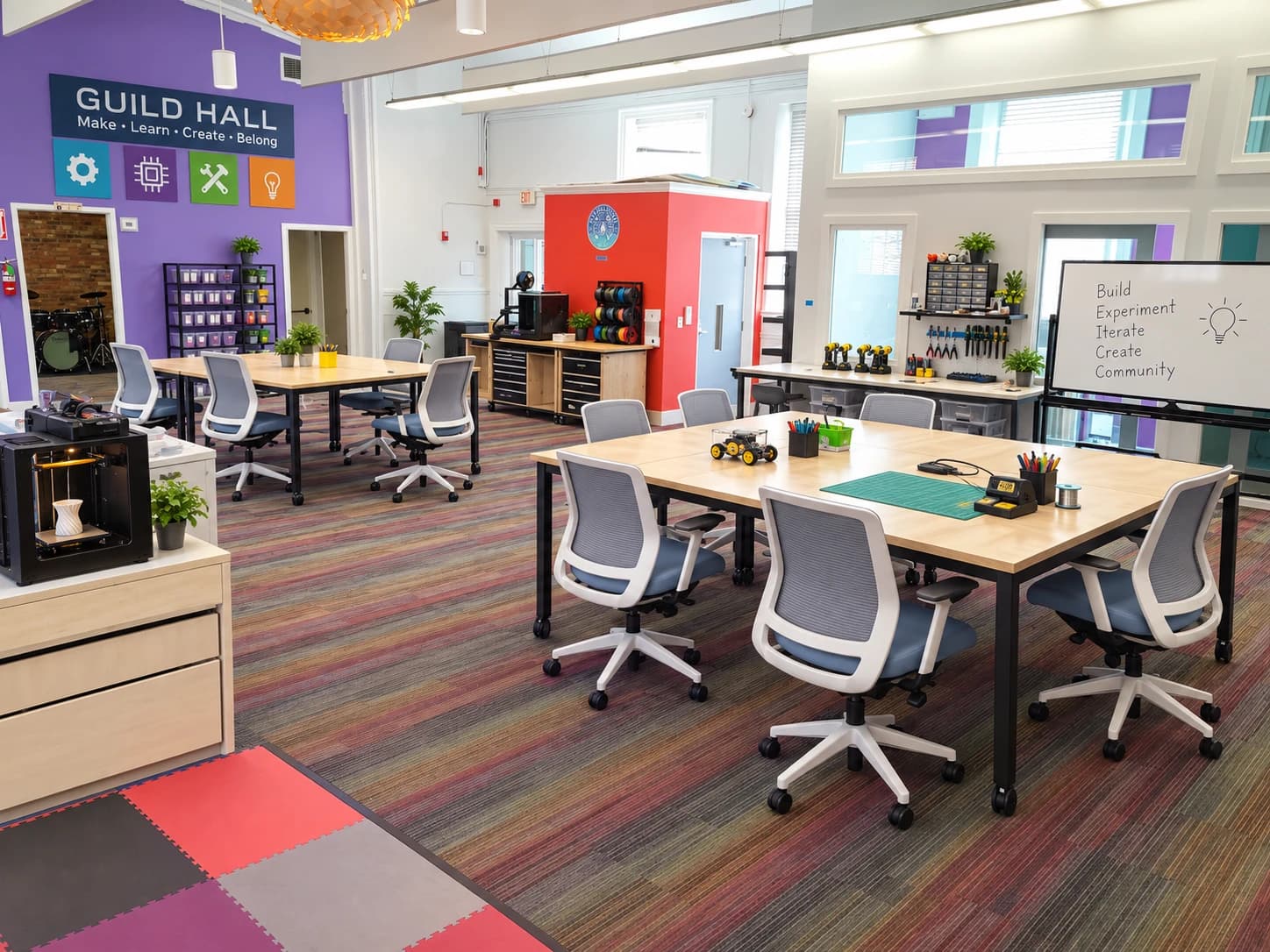
An organized makerspace with clear worktables, neatly arranged chairs and equipment, and no people
Design the space around what your learners will do there.

A plan built around your organization

Understand what is working. Design what comes next.

A comprehensive review starts with your current reality: who you serve, what you teach, how your team delivers it and how you measure success. We work with your leaders and educators to understand strengths, gaps and constraints, then connect recommendations to your mission, budget and capacity. The result is a coordinated approach to program quality and the environment that makes it possible.

Analyze your current programs

Review curriculum, schedules, participation, enrollment and retention trends, learner work and available outcome data. Gather staff and participant perspectives to understand engagement, access barriers and where delivery could improve.

Map opportunities and priorities

Assess staff confidence, equipment use, resources and alignment between activities and learning goals. Identify what to keep, strengthen or introduce, and prioritize recommendations by impact, effort and available budget.

Develop curriculum and experiences

Build a progression of projects, lessons and assessments with real-world applications. Connect STEAM with your wider curriculum, including language arts and creative expression, and map relevant state and ISTE standards to the agreed program.

Design your makerspace

Translate learning activities into a functional layout: collaborative work areas, fabrication and digital learning zones, storage, accessible circulation and supervision. Plan equipment and materials around learner readiness, group size and staff capacity.

Build and equip the space

Turn the design into a phased implementation plan covering furniture, workstations, storage, tool selection, purchasing and setup. Coordinate installation needs with your facilities team and qualified specialists, with responsibilities, costs and site requirements defined before work begins.

Prepare your team and launch

Develop operating routines, tool orientation, supervision practices and maintenance plans. Train educators to facilitate the agreed activities, pilot the program and use feedback to refine the space and learning experience.


The value for your organization

A clear roadmap your team can put to work.

Your agreed scope can include a findings and recommendations report, a prioritized improvement roadmap, curriculum and standards mapping, a space layout, an equipment and materials schedule, a phased budget and a launch plan. Define success measures together—such as participation, engagement, learner progress and staff readiness—so your team can review the impact after implementation.

Your project journey

From assessment to an active learning space.

Start with what you have. Agree the next step together. Build in phases that fit your school, your team and your resources.

  1. Discover

    Share your learners, goals, existing space and budget.

    A shared project brief

  2. Assess

    Review programs, equipment, staff readiness and site needs.

    Priorities grounded in evidence

  3. Design

    Connect curriculum, layout and tools to a phased budget.

    An agreed plan and quote

  4. Build & train

    Equip the space, prepare educators and pilot activities.

    A space and team ready to start

  5. Launch & improve

    Welcome learners, review early results and refine the experience.

    An active learning community

Each phase has an agreed scope. Your school can begin with assessment and planning before committing to a build-out.

Plan the investment

What budget should your school start with?

For a modest pilot, consider an initial equipment and materials allowance of $5,000–$10,000 when you can reuse a room, furniture and computers. A smaller budget can support a narrower set of activities. Begin with your learning goals, then choose what to launch now and what to add later.

These are illustrative planning allowances in USD, not Guild Hall package prices or project quotes. The ranges below cover equipment, materials and furnishings as described. Assessment, design, curriculum development, staff training, shipping, tax and building work are additional and must be scoped separately.

Pilot a maker corner

$5,000–$10,000

Start in an existing classroom or library using your current tables and computers. Focus on reusable hand tools, simple robotics or circuits, storage and starter materials.

A focused starting point for a small pilot.

Equip a dedicated room

$15,000–$35,000

Plan several activity stations, flexible furniture, organized storage and a broader selection of robotics, electronics and entry-level digital fabrication tools.

Assumes a suitable room is already available.

Expand into a fabrication lab

$50,000–$100,000+

Explore more workstations and advanced equipment. The tool mix, capacity and facility requirements can move the investment significantly higher.

Construction and specialist installation require separate estimates.

Budget for the whole first year.

Alongside equipment, include planning and educator preparation, staff time, consumables, software, maintenance and replacement parts. Confirm electrical, ventilation, accessibility and installation needs before selecting machines. Keep a contingency allowance for unexpected costs.

Bring your budget. Build a phased plan.

Share your available funding, student numbers and existing resources. We can scope an assessment first, identify what you can reuse and separate essential launch costs from future additions. Your proposal defines deliverables and fees before work begins.

How to interpret these estimates

These ranges are suggested allowances for early discussion, rather than a supplier-priced bill of materials. As a scale reference, the TeacherGeek Maker Cart 2.0 was listed at $9,347.80 when checked in September 2026; that is one stocked cart, not a complete room or a required purchase. Demco’s planning guide also starts with users and activities. Obtain current itemized quotes for your chosen scope.

Planning with your organization

Can you improve a program or makerspace we already have?

Yes. We can begin with your existing curriculum, space and equipment. The assessment identifies useful resources, underused tools and opportunities to strengthen delivery before recommending additional purchases or changes.

Can we start with analysis before committing to a build-out?

Yes. Program analysis and planning can be scoped as a first phase. You can use the findings to decide which curriculum, staffing or space improvements to pursue and when.

What should we share for a comprehensive review?

Useful starting points include program descriptions, lesson plans, schedules, equipment inventories, floor plans, participation trends and existing evaluation results. We agree what is needed during discovery; aggregated or de-identified learner information is usually sufficient for initial planning.

Do you work with organizations beyond schools?

Yes. The approach can support libraries, community centers, nonprofits and other organizations developing learning programs. We shape the audience, activities, space and operating model around your setting.

What does makerspace build-out include?

The proposal defines the design, equipment sourcing, furnishings, setup, staff preparation and launch support included. Building alterations, electrical work, ventilation and other specialist work are coordinated with your facilities team and appropriate qualified contractors. Site requirements and responsibilities are confirmed before implementation.

Can staff training be included?

Yes. We can connect the project with Guild Hall’s educator professional development, from facilitation and curriculum planning to leadership, inclusive practice and equipment orientation. Any Express Grant eligibility applies to approved training and eligible employers; it should not be assumed to cover program consulting, equipment or construction.

Tell us what you want this experience to make possible.

Start with your audience, goals and preferred dates. We’ll help you choose a practical format and confirm the scope, availability and cost.